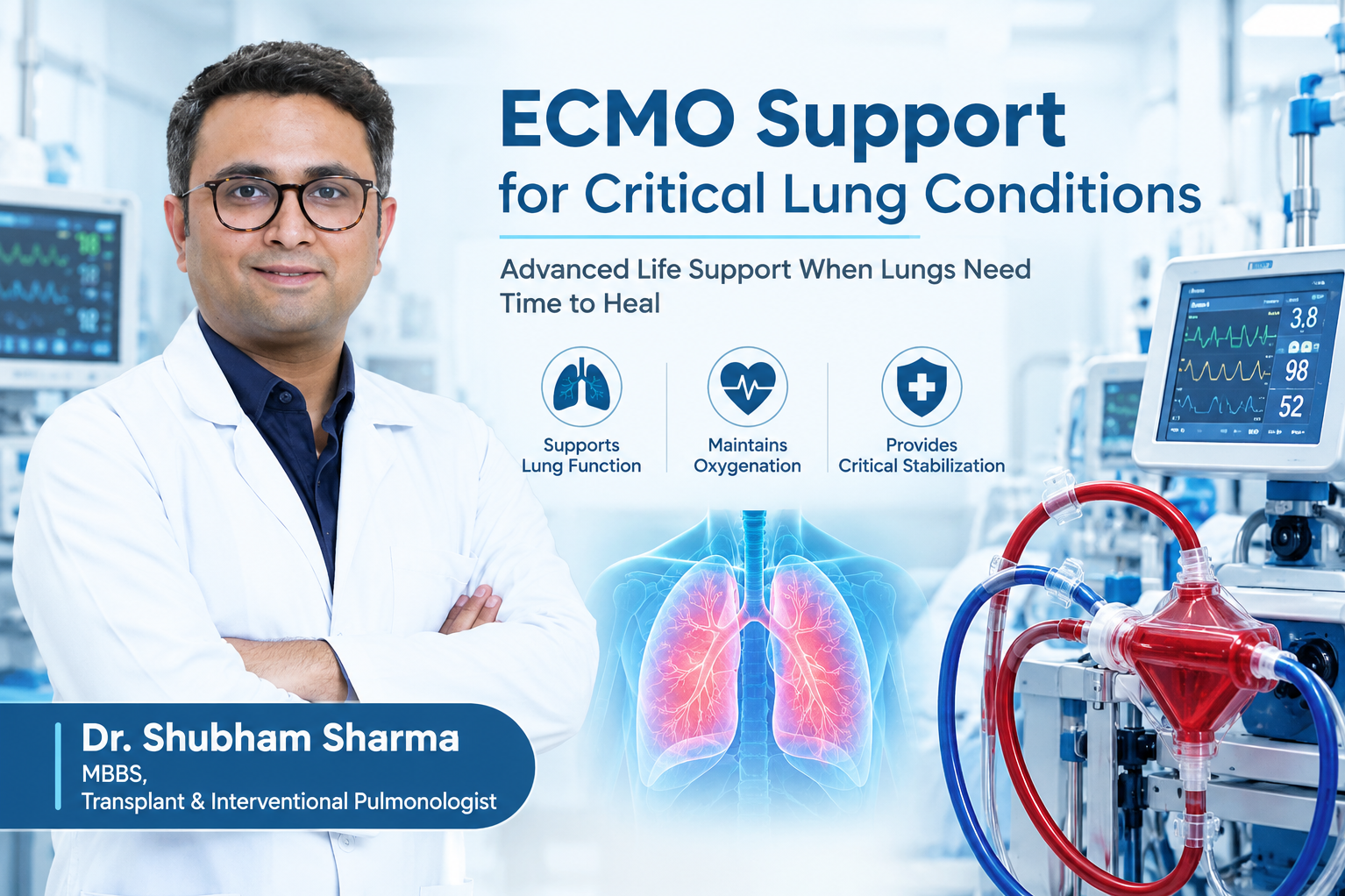
ECMO Support for Critical Lung Conditions | Dr. Shubham Sharma
Severe lung conditions can sometimes cause respiratory failure, making it difficult for the lungs to supply enough oxygen to the body or remove carbon dioxide effectively. In such critical situations, Extracorporeal Membrane Oxygenation (ECMO) can provide temporary life support while the lungs recover or the patient receives further treatment.
Dr. Shubham Sharma, Transplant and Interventional Pulmonologist in Jaipur, provides specialized care for complex respiratory conditions, including advanced lung failure and critical respiratory illnesses.
What Is ECMO (Extracorporeal Membrane Oxygenation)?
ECMO is an advanced life-support technique that temporarily performs the work of the lungs and, in certain cases, the heart. Blood is circulated outside the body through a specialised machine, where a membrane oxygenator adds oxygen and removes carbon dioxide before returning the blood to the patient.
ECMO is generally considered when conventional respiratory support, including mechanical ventilation, is not sufficient to maintain adequate oxygen levels or manage severe respiratory failure.
When Is ECMO Support Required?
ECMO may be considered for patients experiencing severe lung conditions that cause life-threatening respiratory failure. These may include:
- Acute Respiratory Distress Syndrome (ARDS): A serious condition in which inflammation and fluid accumulation affect oxygen exchange in the lungs.
- Severe Pneumonia: Serious lung infections that can cause significant breathing difficulties and low oxygen levels.
- Acute Respiratory Failure: A condition in which the lungs cannot maintain adequate oxygen or carbon dioxide levels.
- Severe Lung Infections: Complex infections that may lead to critical respiratory complications.
- Pulmonary Complications: Selected serious lung conditions that do not respond adequately to conventional treatment.
- Bridge to Lung Transplantation: ECMO may support carefully selected patients with end-stage lung disease while they await lung transplantation.
The decision to initiate ECMO depends on the patient's medical condition, overall health, potential for recovery, and assessment by a specialist critical-care team.
How Does ECMO Work?
ECMO works by temporarily supporting the body's oxygenation and carbon dioxide removal processes.
The procedure generally involves the following steps:
- Blood Circulation: Blood is drawn from the patient's body through specially placed cannulas.
- Oxygenation: Blood passes through an artificial membrane oxygenator that adds oxygen.
- Carbon Dioxide Removal: The ECMO system removes excess carbon dioxide from the blood.
- Blood Return: Oxygen-rich blood is returned to the patient's circulation.
- Continuous Monitoring: The medical team continuously monitors oxygen levels, blood flow, and other vital parameters.
ECMO support is provided in a specialised critical-care environment with continuous medical supervision.
Types of ECMO Support
There are two main types of ECMO, selected according to the patient's medical requirements.
1. Veno-Venous (VV) ECMO
VV ECMO primarily supports the lungs. It is commonly used in patients with severe respiratory failure when the heart is functioning adequately but the lungs cannot provide sufficient oxygenation or remove carbon dioxide.
2. Veno-Arterial (VA) ECMO
VA ECMO supports both the heart and lungs. It may be considered in selected patients experiencing severe cardiac or combined heart and lung failure.
Benefits of ECMO Support
ECMO can provide temporary support in selected patients with life-threatening respiratory or cardiac conditions. Potential benefits include:
- Supports oxygen delivery to vital organs.
- Helps remove excess carbon dioxide.
- Reduces the workload on severely affected lungs.
- Allows time for potentially reversible lung conditions to improve.
- May support selected patients awaiting lung transplantation.
- Provides additional support when conventional treatment is insufficient.
ECMO is a complex intervention and does not guarantee recovery. Its suitability and potential benefits vary from patient to patient.
Risks and Considerations of ECMO
Although ECMO can be an important life-support option, it also carries certain risks. These may include bleeding, blood clots, infection, kidney complications, and complications related to cannula placement.
Patients require continuous monitoring and coordinated care from experienced specialists and critical-care teams.
ECMO Support in Jaipur – Dr. Shubham Sharma
Dr. Shubham Sharma is a Transplant and Interventional Pulmonologist with a focus on complex respiratory conditions, advanced lung failure, and sleep medicine. His clinical interests include the evaluation and management of patients with serious lung diseases and advanced respiratory complications.
Patients requiring assessment for ECMO support can consult a pulmonology specialist to understand the available treatment options, clinical requirements, and suitability for advanced respiratory support.
For patients and families seeking information about ECMO support in Jaipur, specialist consultation can help explain the treatment process and the role of ECMO in managing critical lung conditions.
Frequently Asked Questions (FAQs)
1. What is ECMO support for lung patients?
ECMO is a temporary life-support treatment that helps oxygenate the blood and remove carbon dioxide when severely affected lungs cannot perform these functions adequately.
2. Is ECMO used for severe respiratory failure?
Yes. ECMO, particularly VV ECMO, may be considered in selected patients with severe respiratory failure when conventional treatment is insufficient.
3. What is the difference between VV ECMO and VA ECMO?
VV ECMO primarily supports lung function, whereas VA ECMO provides support to both heart and lung circulation.
4. Can ECMO help patients with severe pneumonia?
In selected cases, ECMO may provide temporary respiratory support for patients with severe pneumonia and life-threatening respiratory failure.
5. Is ECMO a permanent treatment?
No. ECMO is generally a temporary support system used while the underlying condition is treated or the patient undergoes further medical management.
6. Can ECMO be used before lung transplantation?
Yes. In carefully selected patients with advanced lung disease, ECMO may be used as a bridge to lung transplantation.
7. Who decides whether a patient needs ECMO?
The decision is made by a specialised medical team after evaluating the patient's condition, organ function, treatment response, and overall suitability.
Conclusion
ECMO support plays an important role in managing selected cases of severe respiratory failure and critical lung conditions. By temporarily supporting oxygenation and carbon dioxide removal, it can provide valuable time for treatment and potential lung recovery. Consultation with an experienced pulmonology and critical-care team helps determine whether ECMO is an appropriate option for an individual patient.
Keywords