Advanced EBUS-TBNA for Lung Diagnosis in Jaipur | Dr. Shubham Sharma
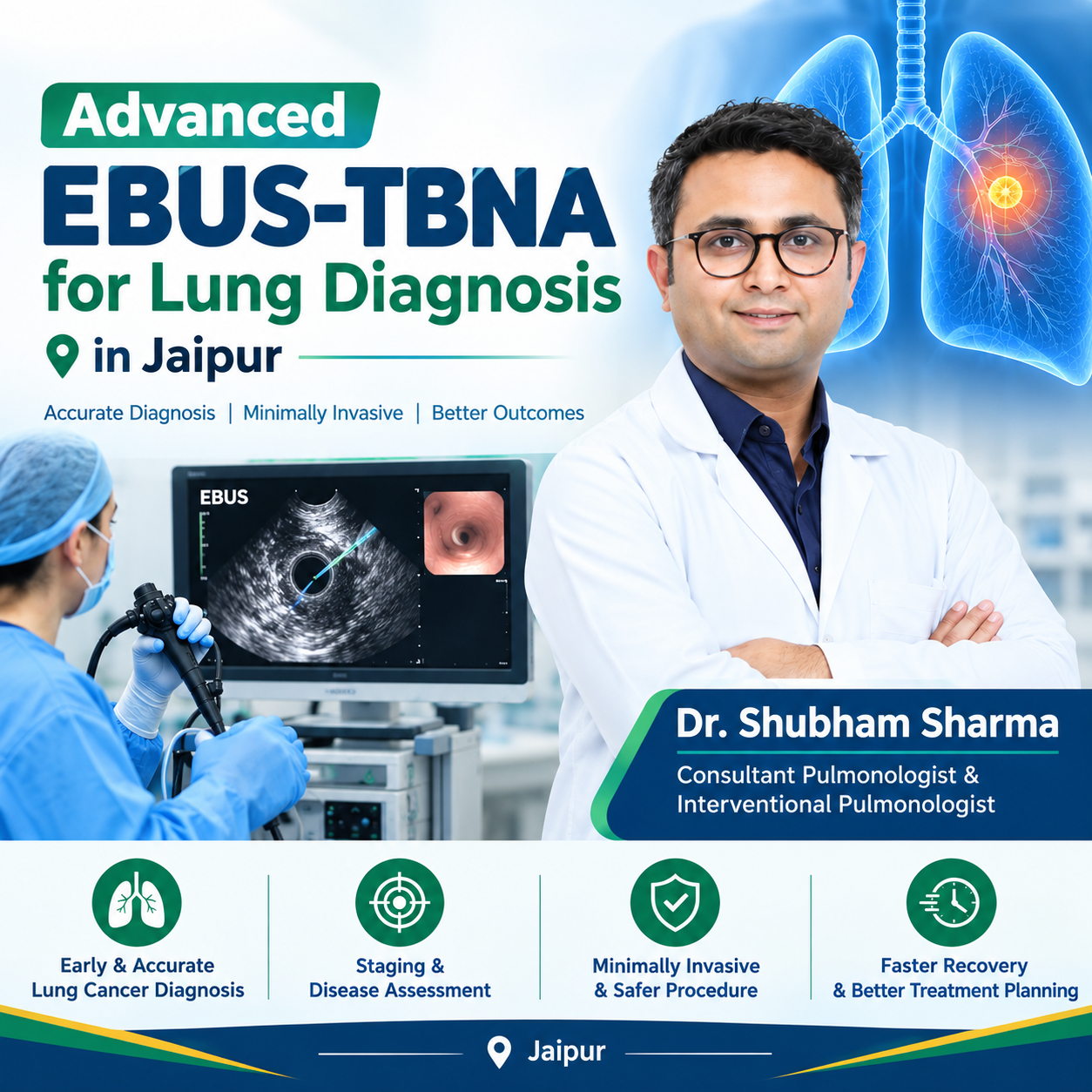
Accurate diagnosis plays an important role in the effective management of lung diseases. EBUS-TBNA (Endobronchial Ultrasound-Guided Transbronchial Needle Aspiration) is an advanced, minimally invasive diagnostic procedure that helps doctors examine and collect tissue samples from lymph nodes and masses located around the lungs and within the mediastinum (the central area of the chest). For patients seeking advanced lung diagnosis in Jaipur, Dr. Shubham Sharma offers specialized care in interventional pulmonology.
What Is EBUS-TBNA?
EBUS-TBNA combines bronchoscopy with ultrasound imaging to help doctors identify lymph nodes and other structures beyond the airway walls. Using a thin, flexible bronchoscope equipped with an ultrasound probe, the doctor guides a fine needle to collect samples from targeted areas without requiring an external incision.
The collected samples are examined in a laboratory to help identify the underlying cause of abnormal findings and guide further treatment decisions.
When Is EBUS-TBNA Recommended?
A pulmonologist may recommend EBUS-TBNA in selected cases to investigate:
- Lung cancer: To help diagnose suspicious lymph nodes or masses and assess cancer spread within the chest.
- Enlarged chest lymph nodes: To determine the possible cause of abnormal lymph node enlargement.
- Sarcoidosis: To obtain tissue samples when this inflammatory condition is suspected.
- Tuberculosis and other infections: To investigate selected cases where lymph node sampling may help establish a diagnosis.
- Other chest abnormalities: To evaluate certain masses or lymph node changes identified through CT scans or other imaging tests.
The suitability of EBUS-TBNA depends on the patient's symptoms, imaging findings, medical history and suspected condition.
Key Benefits of EBUS-TBNA
EBUS-TBNA offers several potential advantages over more invasive diagnostic procedures:
- Minimally invasive approach: Samples can be collected through the airways without an external surgical incision.
- Real-time ultrasound guidance: Helps the doctor target specific lymph nodes and tissue structures.
- Supports accurate diagnosis: Laboratory analysis of collected samples can help guide further evaluation and treatment.
- Useful in lung cancer staging: Can help determine whether nearby chest lymph nodes contain cancer.
- Potentially faster recovery: Many patients can return home the same day, depending on their condition and the clinical setting.
Although EBUS-TBNA is generally considered safe, complications such as bleeding, infection or reactions to sedation can occur. Occasionally, a sample may be insufficient, requiring additional testing.
What Happens During an EBUS-TBNA Procedure?
The procedure typically involves three stages:
1. Preparation: The medical team reviews the patient's medical history, medications, allergies and imaging reports. Fasting and medication instructions are provided before the procedure.
2. Ultrasound-guided sampling: A flexible bronchoscope is passed through the mouth into the airways. Ultrasound helps locate the target, and a fine needle is used to collect tissue samples.
3. Recovery and reporting: The patient is monitored after the procedure. Samples are sent for appropriate laboratory testing, and the doctor explains the results and recommends the next steps.
The procedure's duration, type of sedation and recovery time vary depending on the individual case.
Why Consult Dr. Shubham Sharma for EBUS-TBNA in Jaipur?
Dr. Shubham Sharma is a Transplant and Interventional Pulmonologist with expertise in respiratory critical care, advanced lung failure and sleep medicine. His professional training includes a DNB in Respiratory Diseases, the European Diploma in Adult Respiratory Medicine and a fellowship in lung transplantation at the Medical University of Vienna.
His focus on interventional pulmonology supports the evaluation of complex respiratory conditions using appropriate diagnostic procedures, including EBUS-TBNA. Each patient's investigation and treatment plan is guided by their clinical needs and diagnostic findings.
Book an EBUS-TBNA Consultation in Jaipur
If you have enlarged chest lymph nodes, an unexplained lung abnormality or require further evaluation following an imaging scan, consult a qualified pulmonologist to understand the available diagnostic options.
Dr. Shubham Sharma
Speciality: Transplant & Interventional Pulmonology
Location: Rama Speciality Clinics, Pratap Nagar, Main Tonk Road, Jaipur, Rajasthan
Contact the clinic to discuss your symptoms, reports and whether EBUS-TBNA is appropriate for your condition.
Frequently Asked Questions
1. What is EBUS-TBNA used for?
EBUS-TBNA is used to collect samples from selected lymph nodes and masses around the airways to investigate conditions such as lung cancer, sarcoidosis and certain infections.
2. Is EBUS-TBNA a surgical procedure?
It is a minimally invasive bronchoscopic procedure that generally does not require an external incision.
3. Is EBUS-TBNA painful?
Local anaesthesia and sedation are commonly used to improve comfort. The experience varies from patient to patient.
4. How long does recovery take after EBUS-TBNA?
Many patients are discharged the same day after observation, but recovery and discharge depend on the patient's condition and the medical team's assessment.
5. Where can I consult for EBUS-TBNA in Jaipur?
You can contact Dr. Shubham Sharma's clinic in Pratap Nagar, Jaipur, to discuss the procedure and appointment availability.
Conclusion
EBUS-TBNA is an important diagnostic option for evaluating selected lung and chest lymph node abnormalities. With specialized interventional pulmonology care, patients can receive a structured evaluation and appropriate guidance for further diagnosis and treatment. For EBUS-TBNA consultation in Jaipur, contact Dr. Shubham Sharma to discuss your diagnostic needs.
Keywords